

July 8, 2026 · Michael Rodriguez

Where Exactly Does a Customer Conversation Get Dropped Between Dealership Systems?
A dealer-floor map of the exact handoffs where a customer conversation dies between your DMS, CRM, and service tools, why those seams fail, what they cost, and how to find your own before you buy anything.
I sell cars for a living, so I will tell you where the money actually leaks. It is not inside your CRM. It is not inside your DMS. It is in the space between them, at the exact moment a customer conversation is supposed to move from one system to the next and nothing carries it across.
A customer relationship is not one event. It is a conversation that moves. It starts as a website visit, becomes a lead, becomes a sale, becomes a service customer, becomes a repeat buyer. Every one of those stages lives in a different system. And every place two systems are supposed to hand off is a place the conversation can quietly die.
The short answer
A customer conversation gets dropped at the handoffs between systems, not inside any single tool. The specific drop points are always the same four seams: website to CRM, CRM to a live person, service drive to sales, and past buyer back to in-market. Each system owns a slice of the customer and none owns the whole thread, so the conversation dies at the jump. To find your own drops, map the path a real customer takes through your store and mark every point where they move from one system to another.
Definition
System handoff:
The moment a customer's information or momentum is supposed to pass from one dealership system to the next, for example from the website lead form into the CRM, or from the service record over to sales. A handoff fails when nothing carries the conversation across the gap, so the customer stalls in the space between two tools that were never built to share a record.
Where exactly does the conversation get dropped?
At the seams, every time. The tools themselves mostly work. What breaks is the pass between them.
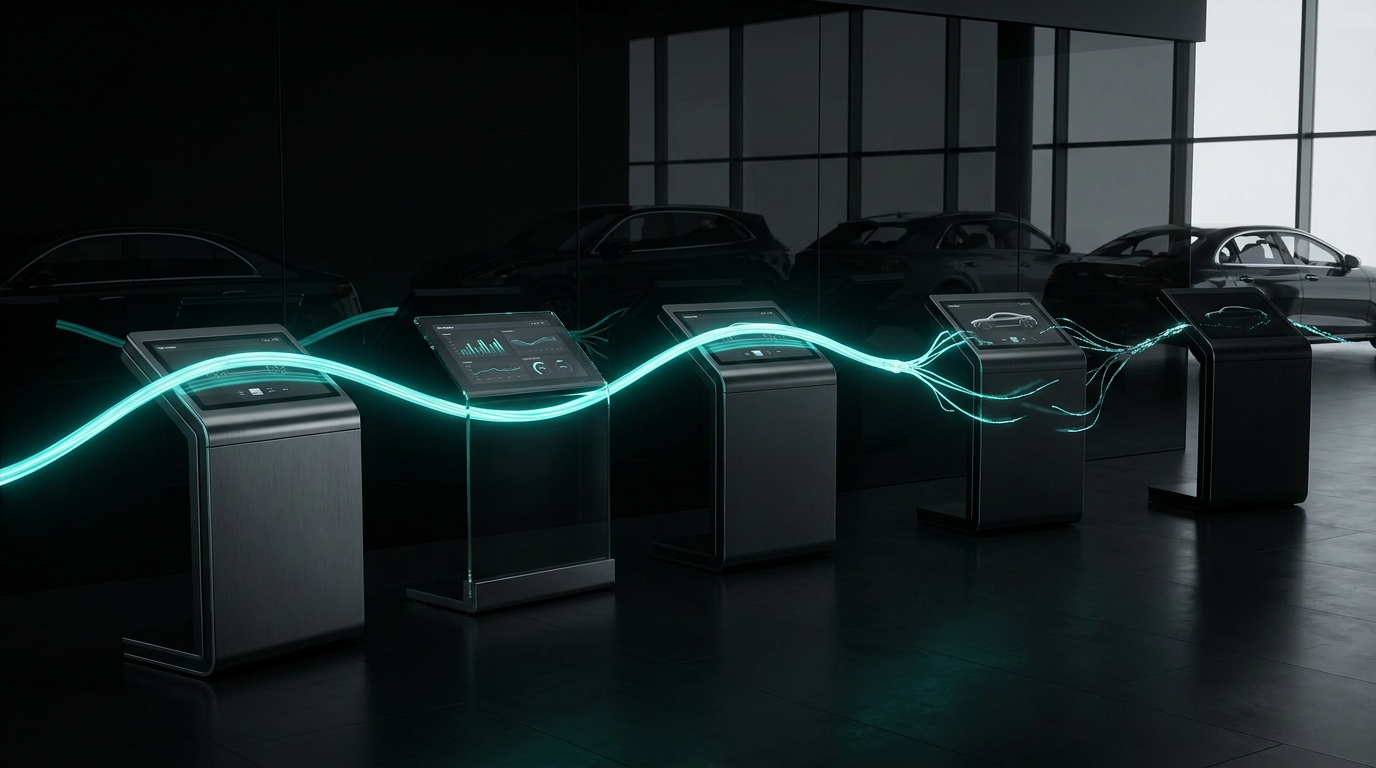
Think of one customer as a single thread that should stay unbroken from first click to repeat purchase. In most stores that thread is bright inside each system and frays to nothing at the borders. The website knows they were shopping a specific trim. The CRM gets a name and an email and loses the browsing context. The salesperson gets a lead card and never sees the service history sitting one department over. Nobody is doing anything wrong. The store just has no layer that keeps the thread whole as the customer crosses from one tool to the next. That gap is the orchestration problem: not a broken tool, a broken pass.
Why do the handoffs fail in the first place?
Because your systems were never built to share a customer. They were bought to share nothing.
Your DMS was bought to run the back end. Your CRM was bought to manage leads. Your service tools were bought to run the drive. Three vendors, three jobs, three different years. Each one holds its own version of the customer, and those versions do not agree with each other. This is not a hunch. In Cox Automotive's 2024 Power of Data study, more than half of dealers said they deal with data that contradicts itself across their tools.
When the same customer exists as three records that disagree, the handoff has nothing clean to pass. So the pass ends up depending on a person: a manager remembering to walk a lead across the hall, a service advisor thinking to mention an equity position to sales. Depend on memory across a busy Saturday and the conversation gets dropped by default, not by mistake. I wrote about the cash side of this in the hidden integration tax. This is the other half: the deals that fall through the same gaps.

What are the specific drop points in a real store?
There are four, and you can walk every one of them through your own floor.
Website to CRM. A shopper spends twenty minutes on a specific vehicle, then fills out a form. The CRM gets the name and the email. It usually loses what they were actually looking at. The richest signal, intent, dies at the first handoff, so your team follows up blind on a customer the website already understood.
CRM to a live person. A buyer submits a lead at 8:40 PM. The CRM logs it perfectly. Your BDC is gone and your salespeople are home. By the time someone opens it at 9 the next morning, that customer has already heard back from two other stores. The system captured the lead. It had no way to finish the conversation when the conversation actually happened.
Service drive to sales. Your service lane is the richest source of in-market customers you own. People in your lounge are often in a strong equity position, one good conversation from an upgrade. The service system knows the vehicle, the mileage, the history. Sales never sees it, because the two systems do not share a customer. The handoff that should be automatic is a hallway conversation that happens by luck or not at all.
Past buyer back to in-market. Someone you sold to three years ago just started shopping again. The signal exists. It lives outside your CRM or buried in data nobody watches, so you find out when they show up on someone else's lot. Knowing which past customer is back in-market is worth more than another email blast to your whole list, but only if something connects that signal to a person who can act.
The drops are not random. They are always at the same four seams: website to CRM, CRM to a live person, service to sales, and past buyer back to in-market. Fix the seams and you keep customers you already paid to attract.
What does a dropped conversation actually cost?
More than most stores can see, because the biggest losses never enter a system to be counted.
Foureyes analyzed lead handling across 22,500 dealership websites and found that a large share of leads are simply mishandled, and a meaningful chunk never make it into a CRM at all.
Read that second number twice. If a lead is never logged, it is not a bad follow-up, it is an invisible one. It cannot show up in a report, so it never makes it into the conversation about what the store is losing. That is what makes dropped handoffs so expensive: the loss is real, and it is quiet.
The reason speed matters underneath all of this is not a slogan. In the MIT and InsideSales.com Lead Response Management study, the odds of qualifying a lead were dramatically higher when the store responded within five minutes instead of thirty.
Source: MIT and InsideSales.com Lead Response Management Study
That is industry data, not an AvI result. But it sets the stakes. The window that decides a deal is measured in minutes, and a conversation stuck in the gap between two systems is a conversation that misses that window every time.
Where does the leak run worst?
Between sales and service, and after hours. Those are the two seams where your systems are most divided and your people are least available.
Sales and service run on different software, different logins, and often different cultures. The customer the drive sees every ninety days is a stranger to the sales floor. And after hours, when a real buyer finally has time to shop, there is no person on either side of any handoff. The system dutifully logs the lead into a gap and waits for a morning that arrives too late. Both of these are fixable, but only once you have named them as specific handoffs instead of a vague sense that follow-up could be better.
The tell
If your honest answer to "how many places does the same customer live in your store" is "three or four, and they don't match," you have already found where your conversations are getting dropped.
How do I find where my own store drops conversations?
You map the path, then mark the jumps. That is the whole method, and it comes before any tool.
Walk one real customer through your store on paper. Website visit. Lead. First response. Showroom. Sale. First service visit. Second service visit. Trade cycle. At every step, ask one question: does the customer jump from one system to another here, and if so, what carries them across? Every jump with no clean carrier is a drop point. Most stores are surprised how many they have once they see it laid out, because each one felt like a small thing on its own.
You cannot fix a handoff you have not named. Map the seams first, tools second.
Notice what this is not. It is not shopping for an AI tool and hoping it happens to plug your gaps. A tool aimed at a seam you have not identified will demo beautifully and change nothing. Orientation before execution. Name the drops, size what they cost, then and only then decide what belongs on top of the systems you already run. That is the discipline behind how we approach integration: orchestrate the tools you own before you replace any of them.
The point is not to add software. It is to close the seams.
Your DMS, CRM, and service tools are not the problem. The unguarded space between them is. That is where the after-hours buyer, the equity customer in your lounge, and the past owner quietly back in-market all slip out, and none of it shows up as a line item, which is exactly why it stays expensive.
The move
Map the path a real customer takes, mark every system-to-system jump, and price what the unguarded seams cost you each week. Then decide what to connect. Clarity first, tools second.
So before the next vendor sells you a tool for a gap you have not measured, walk your own store's path and find the seams yourself. That is exactly what we do on a 30-minute diagnostic call: map where your systems stop talking and show you the drop points before you spend a dollar on anything. Worth a look before you buy?
Frequently asked questions
Where does a customer conversation get dropped between dealership systems?
At the handoffs, not inside any single tool. The conversation dies in the seams where a customer moves from one system to the next: website to CRM, CRM to a live person, service to sales, and past buyer back to in-market. Each system owns a slice of the customer and nothing carries the thread across the gap.
Why do the handoffs between dealership systems fail?
Because the systems were never built to share a customer. Your DMS, CRM, and service tools came from different vendors at different times, each holds its own version of the record, the versions disagree, and nothing sits above them to pass the conversation from one to the next.
What do dropped conversations actually cost?
Deals that never show up as a line item. Foureyes found 43.2% of dealership sales leads are mishandled and 14.1% are never logged to a CRM at all, so much of the loss is invisible because it never entered a system to be counted.
How do I find where my own store drops conversations?
Map the path a real customer takes through your store and mark every point where they jump from one system to another. Those jumps are your drop points. Do it before buying any tool, because a tool cannot fix a handoff you have not named. See the orchestration problem for the bigger picture.
Sources
- Cox Automotive, "Power of Data Study" (2024). mediaroom.kbb.com
- Foureyes, "2025 Automotive Dealer Benchmarks Report" (2025). prweb.com
- J. Oldroyd et al., MIT and InsideSales.com "Lead Response Management Study." onecavo.com
> FAQ
Where does a customer conversation get dropped between dealership systems?
At the handoffs. Not inside any one tool, but in the seams where a customer moves from one system to the next: website to CRM, CRM to sales floor, service drive to sales, past buyer back to in-market. Each system owns a slice of the customer, and no shared layer carries the thread across the gap, so the conversation dies at the jump, not inside the box.
Why do the handoffs between dealership systems fail?
Because the systems were never built to share a customer. Your DMS, CRM, and service tools came from different vendors at different times to do different jobs. Each holds its own version of the record, the versions disagree, and nothing sits above them to pass the conversation from one to the next. The handoff that should be automatic ends up depending on a person remembering to do it by hand.
What do dropped conversations actually cost a dealership?
They cost deals that never show up as a line item: the after-hours lead nobody answered, the service customer in equity nobody pitched, the past buyer who went back in-market with no one watching. Foureyes found 43.2% of dealership sales leads are mishandled, with 14.1% never logged to a CRM at all, so a large share of the loss is invisible because it never entered a system to be counted.
How do I find where my own store drops conversations?
Map the path a real customer takes through your store and mark every point where they jump from one system to another. Those jumps are your drop points. Do this before you buy any AI tool, because the tool cannot fix a handoff you have not named, and most stores are surprised by how many seams they have once they walk the path on paper.
Michael Rodriguez
20 years in automotive retail, currently selling cars at the #1 volume Chevrolet dealer in the world. Michael builds and operates AI workflows on a real dealership floor, then translates what holds up for other operators. Used to diagnose systems, not sell software.
Want a clear-eyed read on where AI actually helps your store? Start with the twelve-question Reality Check, or talk to an operator.