

September 14, 2026 · Michael Rodriguez

Fixed-Ops Signals That Should Trigger a Sales Conversation
Most dealerships wait for the customer to raise their hand. These fixed-ops data points tell you the hand is already up.
The short answer
Definition
Fixed-Ops Lead Signal: A fixed-ops lead signal is a recorded event inside the service lane, parts counter, or repair order system that correlates with elevated likelihood of a near-term vehicle purchase or trade. Unlike a form fill or a click, it is a behavioral fact about the customer's current relationship with their vehicle.
Service departments in a typical rooftop handle more customer interactions per week than the sales floor sees in a month. That volume is a data asset. The problem is that most of it lives in the DMS, gets reviewed for parts margins and labor hours, and is never surfaced to a sales manager in a structured way.
Why does fixed-ops data predict purchase intent?
Purchase intent builds gradually. A customer who just bought is satisfied. A customer two years in is starting to notice rattles. A customer four years in with a transmission quote in hand is already doing mental math on whether the repair is worth it. Fixed-ops records that progression in timestamps, dollar amounts, and technician notes. Sales CRM systems rarely see any of it.
The service lane is the most honest place in the dealership. Customers tell their advisor things they would never say to a salesperson.
The advisor relationship is lower-stakes emotionally, so customers are candid. "I'm thinking about getting rid of this thing" is a comment that disappears into a paper RO unless there is a process to capture and act on it.
What specific signals should trigger a sales conversation?
Not every service visit warrants an outreach. The goal is precision, not volume. The following categories have the strongest correlation with near-term purchase readiness.
Repair cost threshold crossings When a single repair estimate exceeds a defined percentage of the vehicle's trade value, the customer faces an explicit keep-or-replace decision. Many advisors walk customers through this math already; the signal needs to reach the desk before the customer leaves the lot.
Mileage milestones combined with model year age A vehicle crossing 80,000 or 100,000 miles is entering a cost-of-ownership inflection zone. Pair that with a model year that is now four or more years old and the case for a trade conversation strengthens. The DMS has both data points.
Repeated visits within a 90-day window A customer who returns for a second or third unrelated repair in a quarter is experiencing ownership fatigue. The pattern is more predictive than any single visit.
Declined services that carry long-term cost implications When a customer declines a timing belt, transmission service, or suspension work and the advisor notes it as deferred, the store has documentation that the vehicle's reliability trajectory is declining. That is a legitimate, non-pressured reason to open a financial conversation.
Trade appraisal requests at the service counter This is the clearest signal in the set. A customer asking "what would this be worth as a trade?" while waiting on an oil change has self-identified. Response time matters here. Deals lost to competing stores are frequently lost because no one responded same-day.
Advisor verbatim notes flagging purchase intent language Advisors hear it constantly: "I need to just get a new one," "this is getting ridiculous," "my wife wants me to trade it in." A structured note-capture habit, with a defined category or flag in the DMS, routes this to BDC or sales without relying on memory or hallway conversations.
Note
How should the handoff from service to sales actually work?
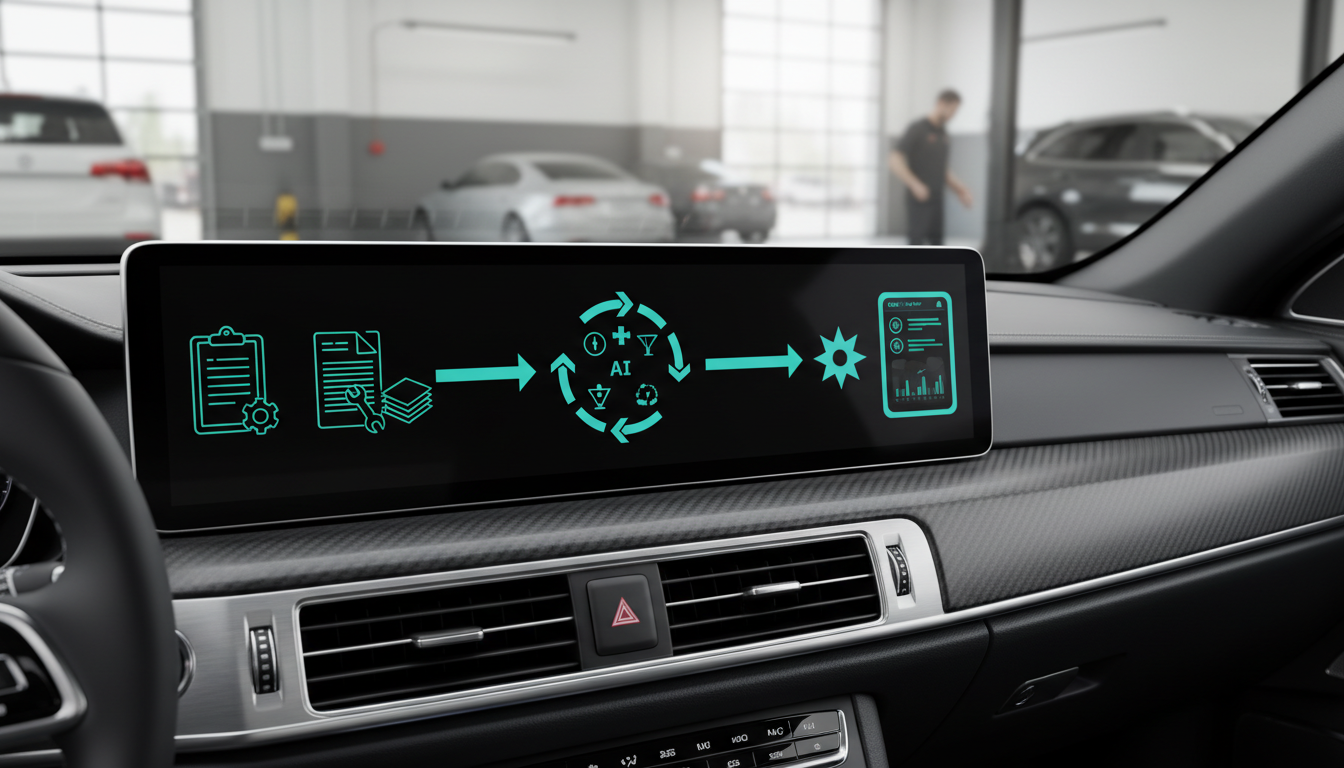
A clean handoff requires three components: a trigger definition, a routing rule, and a response protocol. Without all three, signals accumulate without action.
The trigger logic can be as simple as a flagged RO category or as sophisticated as a scored model that weights multiple signals. The routing rule determines who receives the alert and in what form. The response protocol defines what the BDC or salesperson says, because a clumsy first contact can undo a warm signal.
For stores that want to read deeper on CRM integration patterns, the lead intelligence page covers how structured data routing connects to contact strategy.
What the contact should and should not do The customer does not know they have been "triggered." The outreach should feel like attentive service follow-up, not a sales call. Opening with the vehicle's recent history, acknowledging the repair, and asking about satisfaction is the correct entry point. Jumping directly to "ready to trade?" reads as opportunistic.
What does this look like as a scannable process checklist?
Below is a practical trigger set a service manager and sales manager can agree on without a technology overhaul.
- Single estimate exceeds 40 percent of current trade value: route to desk manager same day
- Vehicle is 48 months or older and shows 75,000 miles or more: flag for BDC 30-day outreach
- Two or more ROs in a rolling 90-day window, different systems: flag for advisor conversation
- Any declined service item with labor estimate above a defined dollar threshold: log in DMS note category "deferred major"
- Customer makes any verbal purchase intent comment: advisor logs in structured note field, BDC receives alert
- Customer requests trade value at service counter: immediate warm walk or same-day sales contact
The threshold numbers above are starting points. Each store should calibrate them against its own close rate data and average transaction history.
Are there published frameworks that support this approach?
The National Automobile Dealers Association has documented in its annual data reports that service retention correlates with repeat purchase behavior, with customers who service at the selling dealer showing measurably higher repurchase rates. The NADA data resources provide the broader retention context for this strategy.
Cox Automotive's annual Car Buyer Journey study tracks how purchase decisions develop over time and consistently shows that the consideration phase begins months before a showroom visit, often triggered by a negative ownership experience, which fixed-ops records directly.
For a diagnostic read on how your current CRM and DMS are or are not connected, the diagnostic call page outlines what that review covers. If you want to see how AI-assisted routing fits into the workflow, the AI reality check explains what the technology does and does not do reliably in this context.
Note
Fixed-ops is not a lead source that needs to be built. It is a lead source that needs to be read. The signals are already there. The question is whether the process exists to act on them before the customer makes the decision on their own or, worse, at the competitor down the street who happened to call first.
Michael Rodriguez
20 years in automotive retail, currently selling cars at the #1 volume Chevrolet dealer in the world. Michael builds and operates AI workflows on a real dealership floor, then translates what holds up for other operators. Used to diagnose systems, not sell software.
Want a clear-eyed read on where AI actually helps your store? Start with the twelve-question Reality Check, or talk to an operator.