
July 19, 2026 · Michael Rodriguez

Time Saver or Work Shifter: A Dealer's Diagnostic Guide to AI Tools
Learn how dealers can distinguish AI tools that save time from those that just shift work, creating new bottlenecks. A practical guide to diagnosing tech ROI.
The short answer
The automotive market is saturated with vendors promising AI-driven efficiency. These tools claim to write perfect emails, predict customer behavior, and automate BDC follow-up. For a General Manager or BDC Director under pressure, the appeal is obvious. The reality, however, is often disappointing. Many of these tools do not eliminate work; they simply transform it into something else, pushing the burden to another part of the process or onto another employee.
This phenomenon is not new, but the rapid deployment of generative AI has amplified it. An AI that generates a customer email in ten seconds seems like a clear win. But if that email requires three minutes of review and editing by a BDC manager to ensure it is accurate, on-brand, and contextually appropriate, the dealership has not saved two minutes and fifty seconds. It has created a new, high-cost job: AI output editor. To make sound technology investments, operators must learn to distinguish true automation from work-shifting theatrics.
Definition
Work Shifting:
Work shifting, in the context of technology implementation, is the reappearance of a supposedly eliminated task in a new form or location within a workflow. Instead of reducing the total human effort required to achieve an outcome, the tool merely changes the nature or timing of the intervention. This often manifests as increased requirements for data preparation, output validation, or manual handling of exceptions the system cannot process.
What Is the Difference Between Task Automation and Workflow Automation?
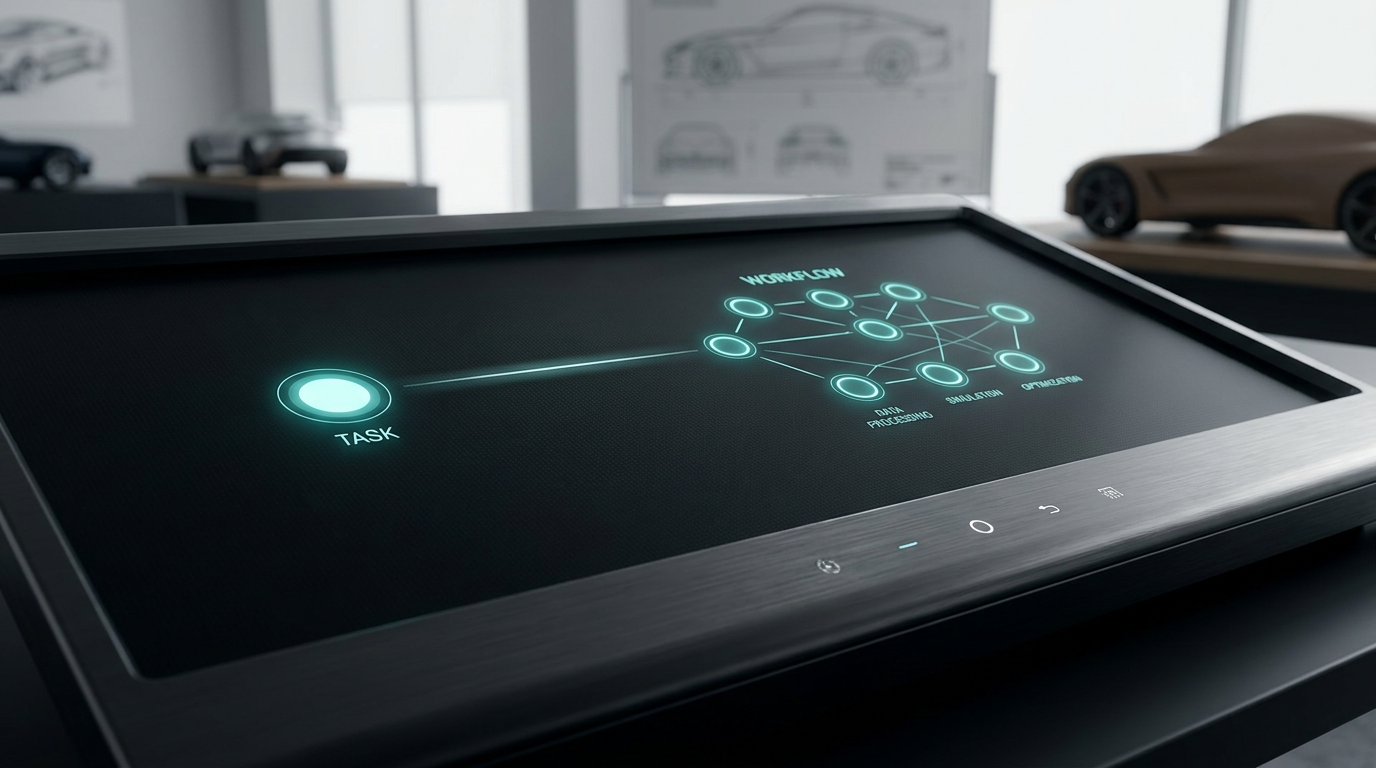
Task automation addresses a single, discrete action, while workflow automation connects multiple systems and stages of a process to reduce the need for human hand-offs. A tool that only automates one task often creates friction at its entry and exit points. True operational leverage comes from automating the connections between tasks.
Consider lead follow-up. A simple AI email-writing tool is an example of task automation. It might help a BDC agent write an initial response faster. The agent still must log into the CRM, find the lead, copy and paste information, select a template, trigger the AI, review the output, and then manually schedule the next step. The core inefficiency of context switching and navigating disparate systems remains.
Workflow automation addresses the entire sequence. A workflow-oriented system would:
- Ingest a lead directly from its source.
- Enrich it with data from the DMS and other dealership systems.
- Use rules to qualify and assign the lead to the right person.
- Generate and send a personalized first response, with no manual review needed for standard cases.
- Schedule the next follow-up action in the CRM automatically.
Task automation polishes a single link in the chain. Workflow automation strengthens the entire chain. Many vendors sell task automation disguised as a revolutionary platform, leaving dealers to do the hard work of integrating it themselves. A true partner provides a solution that understands and improves the entire business process. For more on this distinction, see our analysis of AI in the dealership.
How Can Dealers Diagnose a "Work Shifting" AI Tool?
Dealers can diagnose a work-shifting tool by conducting a time study of the complete process before and after implementation, asking critical questions about data handling, validation, and exception management. The focus must be on the net time expended by the organization, not the advertised time saved on one step. Use the following diagnostic checklist to evaluate any potential or current AI tool.
| Diagnostic Area | Red Flag (Likely Work Shifter) | Green Flag (Potential Time Saver) | | :--- | :--- | :--- | | Data Input | Staff must manually export, clean, and format data to feed the tool. | The tool integrates directly with the CRM/DMS via API and ingests data automatically. | | Output Validation | Every output requires careful, line-by-line review by a skilled employee before it can be used. | Outputs for standard scenarios are trusted and used with minimal spot-checking; only exceptions require review. | | Integration | The tool operates in a standalone environment, requiring staff to copy-paste information to or from it. | The tool reads from and writes back to your system of record (e.g., CRM), updating customer records automatically. | | Exception Handling | When the AI fails or encounters an unknown situation, it creates a complex manual recovery process. | The tool flags exceptions clearly and routes them to the correct person with all necessary context for a quick resolution. | | Training Overhead | The tool is so complex that it requires extensive initial training and constant re-training for staff to use it properly. | Onboarding is intuitive, and the tool guides the user, reducing the cognitive load and need for memorization. |
Note
Focus on 'net time saved' across the entire dealership workflow, not the advertised time savings on a single, isolated task.
Asking these questions forces a conversation beyond the vendor's demo. It grounds the evaluation in the day-to-day realities of your operation. If a vendor cannot provide clear answers, or if their answers reveal significant new manual processes, their tool is likely a work shifter.
What Are Key Indicators of a Genuine Time-Saving AI?
A genuine time-saving AI reduces manual data entry, minimizes context switching for employees, and operates with a high degree of autonomy within defined operational guardrails. Its outputs are reliable enough to be used with minimal intervention, directly improving a core business metric like lead response time or appointment set rate.
Three key indicators separate real automation from the hype:
-
It Reduces Cognitive Load: A valuable tool simplifies decisions, it does not create more. For example, instead of showing a BDC agent ten possible leads to call, it prioritizes the top three based on engagement signals and surfaces the relevant history for each. This eliminates the time wasted on analysis and decision-making, allowing the agent to focus on the conversation. This is the core principle behind effective lead intelligence platforms.
-
It Operates on Systems, Not Just Screens: It connects directly to your dealership's systems of record. When an action is taken, like sending an email or setting an appointment, the tool automatically logs that activity in the CRM. This eliminates the manual, error-prone task of post-call data entry and ensures data integrity across your platforms.
-
Its Autonomy is Trustworthy: The most powerful AI tools can execute multi-step processes without human oversight, but only when the conditions are right. A trustworthy system allows managers to set clear rules and guardrails. For example, it might be trusted to handle all new internet leads from a specific source autonomously but configured to flag any lead with a VDP activity history over a certain threshold for immediate manager review. This balance of autonomy and control is critical. According to Gartner, a key reason AI projects succeed is a strong foundation of data management and governance, which builds this trust. Their research highlights that many projects fail before they even scale; a 2023 survey revealed only 54% of AI projects make it from pilot to production.
The goal is not to 'use AI.' The goal is to sell more cars, more efficiently. A tool that creates more review cycles and data entry, no matter how advanced, works against that goal.
How Should a Dealership Pilot a New AI Tool to Measure Its True Impact?
A dealership should pilot a tool by running a controlled experiment with a specific, measurable hypothesis and comparing a test group to a control group. This is the only way to cut through sales claims and measure the actual impact on your dealership's net operational time. A haphazard rollout makes it impossible to determine what is actually working.
A disciplined pilot program follows a clear sequence of steps.
- Define Baseline Metrics: Before you begin, quantify your current process. How long does it take, from end to end, to manage a new internet lead until first contact is made? What is your current appointment set rate? You need a benchmark.
- Isolate Groups: Select a small, representative test group (e.g., two BDC agents) to use the new tool. The rest of the team, the control group, continues using the existing process. Do not contaminate the experiment by mixing groups or processes.
- Run Parallel Processes: Run the pilot for a defined period, typically two to four weeks, to account for variations in lead flow and staff performance. Both groups should be handling a comparable workload.
- Measure Total Time & Outcomes: This is the most critical step. Do not just measure how long the automated task takes. Measure the test group's time spent on setup, training, reviewing outputs, correcting errors, and manual workarounds. Compare their total time and their key outcomes (e.g., appointments set, response quality) against the control group.
- Analyze Net Impact: At the end of the pilot, calculate the net change. Did the test group save total time while maintaining or improving outcomes? Or did the time reappear as 'review' or 'data management' tasks? An article in Harvard Business Review on the ROI of generative AI notes the importance of measuring not just time savings but also improvements in output quality and employee experience.
This structured approach removes guesswork. It replaces vendor claims with dealership data. If you need assistance structuring such a pilot, our team can help you design a diagnostic call to model the potential impact correctly.
Ultimately, integrating AI is a strategic decision that demands operational rigor. By shifting the focus from features to workflows and from task time to total process time, dealership leaders can avoid costly distractions and invest in technology that delivers genuine, measurable results. View our services to see how we implement this philosophy.
Michael Rodriguez
20 years in automotive retail, currently selling cars at the #1 volume Chevrolet dealer in the world. Michael builds and operates AI workflows on a real dealership floor, then translates what holds up for other operators. Used to diagnose systems, not sell software.
Want a clear-eyed read on where AI actually helps your store? Start with the twelve-question Reality Check, or talk to an operator.