
AI Mobility 2026: Open-Source Autonomy, Robotic Mobility Platforms, Embodied AI & Next-Gen AV Components

Automotive Intelligence
Artificial intelligence is redefining the entire mobility landscape not only autonomous driving, but robotics, manufacturing, and the supply chain behind next-generation EVs and AVs.
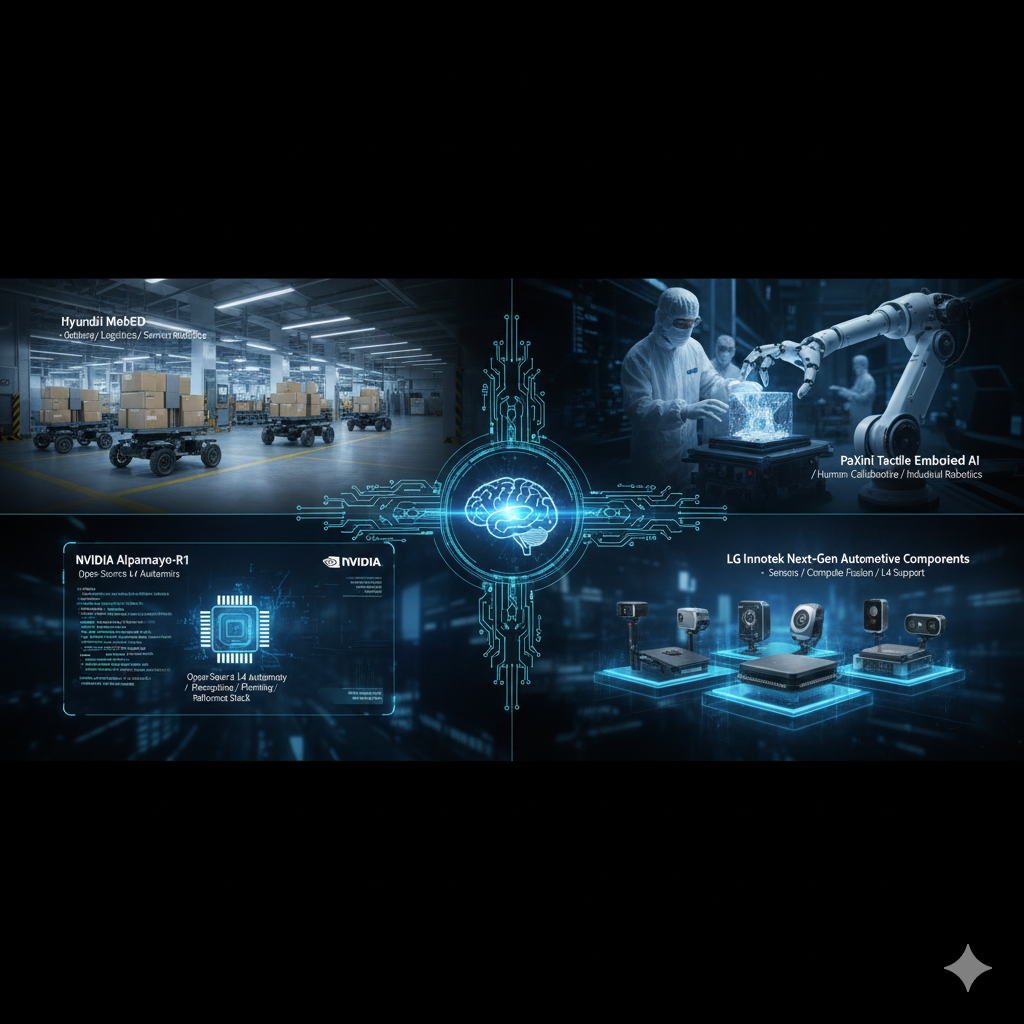
This week’s developments from NVIDIA, Hyundai, PaXini, and LG Innotek reveal a rapidly converging ecosystem where open-source autonomy, robotic mobility bases, tactile embodied AI, and high-performance automotive components shape the next era of intelligent transportation.
Four major breakthroughs highlight how AI is moving from isolated applications to a unified, cross-domain mobility infrastructure.
NVIDIA Expands Open-Source Autonomy with Alpamayo-R1
(NVIDIA)
NVIDIA’s Alpamayo-R1, built on the company’s Cosmos Reason architecture, is emerging as a game-changing open-source platform for autonomous driving R&D.
Designed for OEMs, AV startups, and research labs, Alpamayo-R1 provides:
-
Full end-to-end perception models
-
Prediction and behavior modeling
-
Planning and trajectory generation
-
Reference architectures for rapid prototyping
By lowering the barrier to develop advanced autonomy stacks across the US, Europe, and Asia, Alpamayo-R1 accelerates innovation and encourages standardization something the fragmented global AV ecosystem has long needed.
This democratized autonomy model may become as influential as Linux was for computing.
Is your store ready for AI in 2026? Start your assessment now: https://automotiveintelligence.io/free-ai-readiness-assessment-for-car-dealerships-15-min
Hyundai Unveils Production-Ready MobED Autonomous Mobility Robot
(Hyundai)
Hyundai has introduced a production-ready version of MobED, a compact four-wheeled autonomous robot evolved from its 2022 concept.
MobED serves as a flexible AI mobility base for:
-
Delivery robots
-
Last-mile logistics platforms
-
Hospitality and service robots
-
Autonomous indoor/outdoor micro-mobility systems
Its low profile, high stability, and advanced steering control make MobED useful for both consumer-facing services and industrial applications, highlighting Hyundai’s strategy to merge automotive R&D with robotics expertise in Japan and global markets.
As mobility expands beyond cars, MobED shows how automakers are preparing for a multi-modal, robot-integrated future.
PaXini Advances Embodied AI for Delicate, Human-Collaborative Robotics
(PaXini)
PaXini, a rising robotics company from China, is gaining international attention for its embodied AI robots equipped with advanced tactile sensors.
These robots can:
-
Handle delicate, high-precision tasks
-
Collaborate safely with human workers
-
Adapt to variable environments
-
Support automotive factories and service robotics
As automotive production lines become more automated and AV companies adopt robotic logistics and customer-service bots, PaXini’s tactile intelligence capabilities are increasingly valuable across China, Japan, and Europe.
Embodied AI is becoming the next major frontier for both manufacturing and autonomous mobility ecosystems.
LG Innotek to Showcase Next-Gen AV and EV Components at CES 2026
(LG Innotek)
LG Innotek plans to highlight a full suite of autonomous and EV technologies at CES 2026 targeting major US and European OEMs.
The showcase includes:
-
High-resolution perception sensors
-
Sensor fusion modules
-
Low-latency domain controllers
-
Integrated software supporting L2+ to L4 autonomy
As automakers shift toward centralized compute and software-defined vehicle architectures, LG Innotek’s emphasis on integrated, high-bandwidth sensing and compute control positions it as a critical supplier for next-generation AVs.
A Unified Robotics-Autonomy Ecosystem Is Emerging
From open-source L4 autonomy and robotic mobility platforms to tactile embodied robots and high-performance automotive components, one message is clear:
AI-driven mobility now spans vehicles, robots, chips, and industrial systems forming a unified intelligent ecosystem.
As these technologies mature, 2026 will accelerate the shift toward autonomous, multi-modal, and robotic mobility for consumers, cities, and global industries.
AI isn’t coming it’s here. And it’s already changing how cars are built, sold, and serviced. Are you paying attention?
We bring the news that drives the future and your brand can be part of it. Tap the link in bio to sponsor, subscribe at AutomotiveIntelligence.io, and catch *What The Prompt?* wherever you stream.
Are you a vendor that gets AI and needs to expand your reach, let’s talk https://flow.automotiveintelligence.io/
#FutureOfAuto #DealershipInnovation #AutoTech #AIDrivenRetail #AutoNews